
Interview with Dom Monks
Engineer (of me) turned producer (of me..and Big Thief and others). Freudian studio drama's and first impression of me (none).

I first met Dom, who seems to have near no recollection of meeting me, at Real World Studio’s when I was 18 years old and about to begin recording my second album, I Speak Because I Can. He was, at that time, Ethan Johns’ right-hand man. He was the first person I ever met with a fixed-gear bike, who was as quiet as me and didn’t like butter. He was also the slowest speaker I had ever come across. Still is. Years can pass, fashions can come and go, epochs conclude, while Dom considers the next word in his sentence; It’s no doubt what makes him such a remarkable and much sought-after engineer - unflappable precision.
I have known Dom for nearly 20 years, and he has worked on all but two of my eight albums. He was the reason I was able to make an album shortly after my first child was born. Working with him in that strange, tender time was like working with family. Indeed, he spent most of it with my baby asleep on his chest in the sling.
In this interview, I try to induce him to regale us with stories of me and my great charisma and charm, but he seems, however, to have forgotten them all, and so I ask him about how he became an engineer:
Laura: Where were you coming back from last night?
Dom Monks: I was in London. I was in London picking up a new car.
Laura: Oh, a wagon for all your thousands of children. What is it?
Dom Monks: Yes, because our other wagon died a death. So we have a new wagon. And it’s huge. It is a Peugeot Rifter 70s, which is basically a Citroen Berlingo.
Laura: Beautiful. A Berlingo. That’s pretty exciting. Family car of dreams. Someone’s dreams…
I’m going to start this interview right now, Dom.
Dom Monks: Go for it.
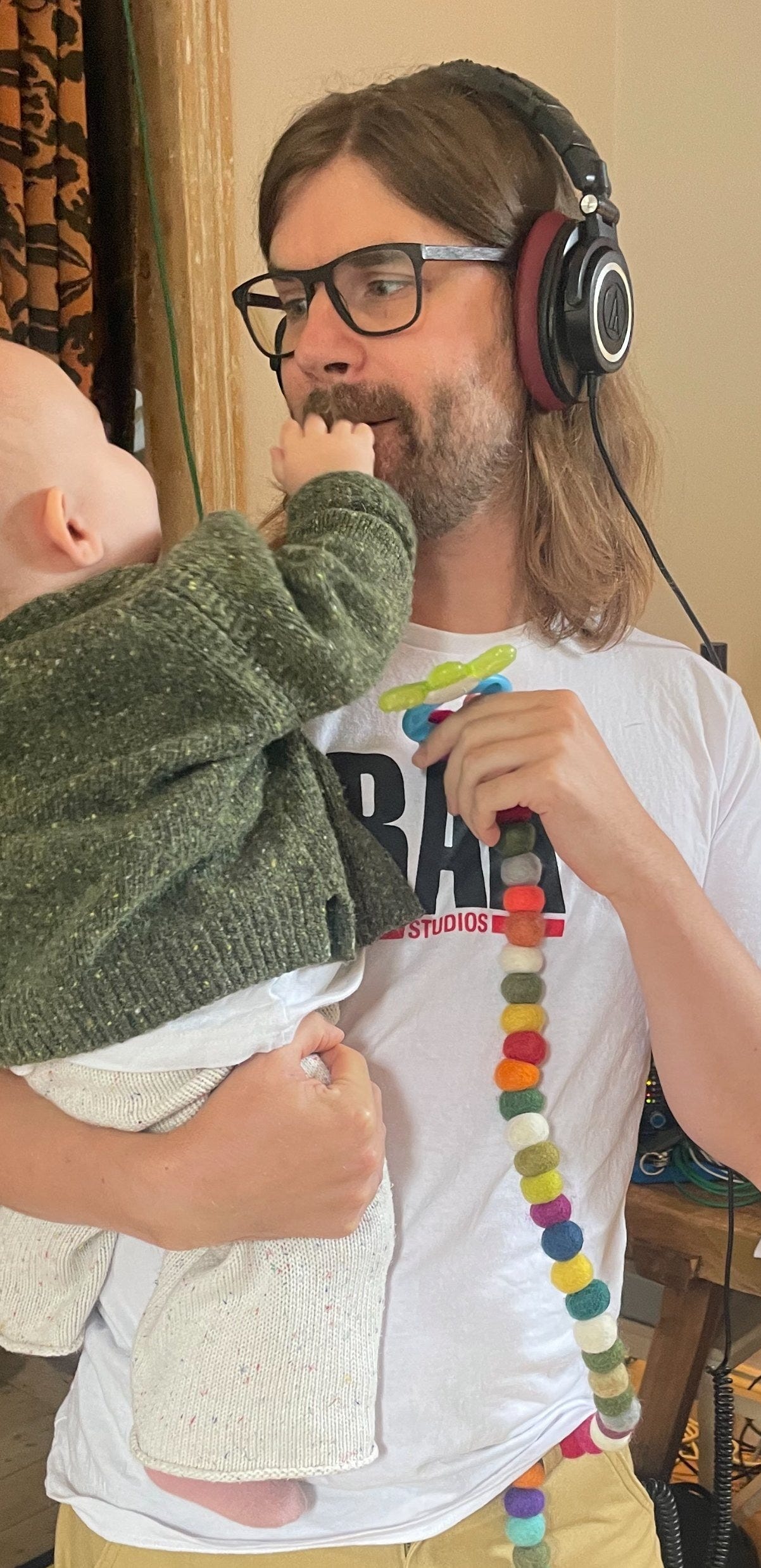
Laura: You have four children.
Dom Monks: Yes.
Laura: How’s that going for you?
Dom Monks: It’s great. It’s wonderful. I mean, it’s perpetual madness. Yeah. But we didn’t learn our lesson after two and three, clearly.
Laura: Well, your wife is a midwife, isn’t she? So she’s a fan of babies.
Dom Monks: Yes. Yes. And... Children, maybe not.
Laura: Children, yeah. Children are a different deal.
Dom Monks: Yes, but no. Life is good. And busy. A lot of crafting, of late. And musical instruments and piercings and everything under the sun.
Laura: Oh, wow. Yeah. You’re at that era. Would you be happy if any of your children turned out to be musicians?
Dom Monks: I mean, I’d be proud. Yeah. I mean, I’d be proud. I’d be impressed. Given that I didn’t turn out as a musician.
Laura: Yeah. Because you come from quite a musical family, don’t you?
Dom Monks: Yes. Yes. My... My mum was a singer. A professional singer when she was younger. A singing teacher. And a music teacher. She taught music at every school I went to.
Laura: Cute.
Dom Monks: It’s less cute when you’re, like, seven. Yeah. Or nine. Or 13. Or any age.
Laura: Why did you go and study engineering? Musical engineering?
Dom Monks: Well... Because... Well, a few things happened. One was kind of getting into electric guitar and bands. And there was an element of realizing I could make the PA work when no one else could figure out how the PA worked. So I was aware that I could kind of problem solve things. And then I kind of somewhat became the de facto person to record things. And then we also had someone who came to the school. He was the keyboard player in the Stone Roses.
Laura: Ooh! They let him into schools, do they?
Dom Monks: Well, he was a latter-day introduction to the Stone Roses. So he wasn’t kind of Ground Zero level. Kind of Rock and Roller. But he came into the school with a gospel choir or something. Anyway, he came and did a kind of production course. Well, he kind of said to me, You should become an engineer. So there was that going on. I got to do work experience at Real World Studios whilst I was at school. Which was pretty wild, in as much as that most of my mates were estate agents doing photocopying for the week. Yeah, same. And I was at Real World [Peter Gabriel’s recording complex near Bath], you know, hanging out with Kylie Minogue.
Laura: How did you get that? Did you just apply?
Dom Monks: It was an option, believe it or not.
Laura: Right, right. Because you were nearby. Because you lived nearby.
Dom Monks: Nearby. And I wasn’t even aware of the place. I don’t think I was even aware of Peter Gabriel.
Laura: I’m still not totally aware of Peter Gabriel…
Dom Monks: So, yeah, I was in there for a week. And it kind of blew my tiny mind, I suppose.
Laura: I bet.
Dom Monks: Going to somewhere, you know, which had lakes and waterfalls running underneath the floors. And amazing grounds and extraordinary rooms. And full of interesting and creative and famous people. It just seemed like a wild place I hadn’t really conceived of. And so I said to them, okay, what do I need to do to get a job here? And they said, oh, well, there’s this good course at Surrey University. And then, whilst I was doing that, they opened up a placement as an assistant to Peter Gabriel’s engineer. And then I managed to get a job back there working for the commercial studios. And was instantly put on a session with Chad Blake. And kind of became his guy.
Laura: Which was... Remind me who Chad Blake is, because I’m so naive to this stuff.
Dom Monks: Well, Chad Blake is... I mean, in the kind of engineering producer world, I think someone described him as like the Jimi Hendrix of engineering. Which I think is probably pretty apt. And he did those early Los Lobos records. And early Sheryl Crow records. He kind of changed the sound of the 90s, basically.
Laura: He simply must be American with a name like Chad Blake.
Dom Monks: Oh, yeah. And then more recently, he did, you know, Black Keys and Arctic Monkeys and big records like that. But yeah. All kinds of incredible, jaw-dropping sounding records. But the biggest thrill was just spending two weeks on a project and finishing it. You know, and actually clearing the patch bay. Seeing it come out in the shops. It was a total revelation to see records being made beginning to end. I think possibly the most exciting thing. There were a few records. But Chad at that time was still a very analog guy, but was becoming increasingly interested in digital. And I suppose I’d had all the digital experience. And I was kind of increasingly interested in analog. So there was a certain exchange of knowledge there. To some extent. And that was the end of him working at Real World. And I helped him set up his own studio. He was kind of one of the first big name mixers to really adopt just mixing entirely in the box, entirely within software. Having been like one of the most analog guys in the industry. He kind of flipped and went, Oh, hang on. I could do this all at home.
Laura: So that was late 2000s. When that shift was happening.
Dom Monks: Yeah. Late 2000s. An incredible time to be at Real World. With lots of artists coming through. And lots of projects happening. Yeah. Great time.
Laura: And that must have been around the time we met. Because yes, we made I Speak Because I Can in 2009.
Dom Monks: Yes. I met Ethan at Real World. I ended up engineering for Ethan and leaving Real World.
Laura: You guys pretty much ran away together into the sunset, didn’t you?
Dom Monks: Yeah, basically. I was supposed to have a job at Abbey Road. But I ended up engineering that Pretenders record with Ethan. And because I was about to leave, Ethan said, would you... how about coming in engineering for me instead of going to Abbey Road? And I said, yes, absolutely. I didn’t have to think about that for a second.
Laura: A million times, yes. Will you marry me?
Dom Monks: Yeah. And so then I had to call up Abbey Road when I was about to start, and I told them I wasn’t coming. And they absolutely hit the roof. Only time anyone’s ever screamed down the phone at me.
Laura: Can’t be true.
Dom Monks: And I thought, well, there we go. I’ve burnt that bridge. But on that Ray LaMontagne record, we ended up going to Abbey Road to do the strings. And so instead of me being like a lowly assistant at Abbey Road, I was coming in as an engineer and everyone had to be nice to me. Including the studio manager. And it was incredibly awkward for me.
Laura: Beautiful. Love that. Love that arc for you.
Dom Monks: Yeah. So that was a funny few months. Which kind of drastically changed the course of things. Yeah. But yes, not very long after that, doing that Ray record, Ethan started talking about you. But the funny thing was, I think I missed the first time... because Ethan wouldn’t kind of explain what was going on, he’d just start talking about stuff. He’d be like, oh, this is a record that’s kind of on the cards. And the first time he said your name, I thought he’d said Laura Marley.
Laura: Okay… So you had a very different image in your mind.
Dom Monks: And I was wondering whether there was some daughter of... Daughter of Bob.
Laura: What a spectacular disappointment. No.
Dom Monks: No, it was not that. But that’s certainly when I do have that memory of being at Real World. And Ethan talking about, in my mind, Laura Marley. And then shortly thereafter discovering that that was not the case.
Laura: No. Couldn’t be further from the case in truth. So, you know, now the really important bit of this interview is me, obviously. Yes. Do you remember when we first met? And what your impressions were?
Dom Monks: Gosh, do I remember when we first met? I’ve got very distinct memories of the studio.
Laura: Ouch.
Dom Monks: Notting Hill. East Coat. Well, where we did all the initial tracking.
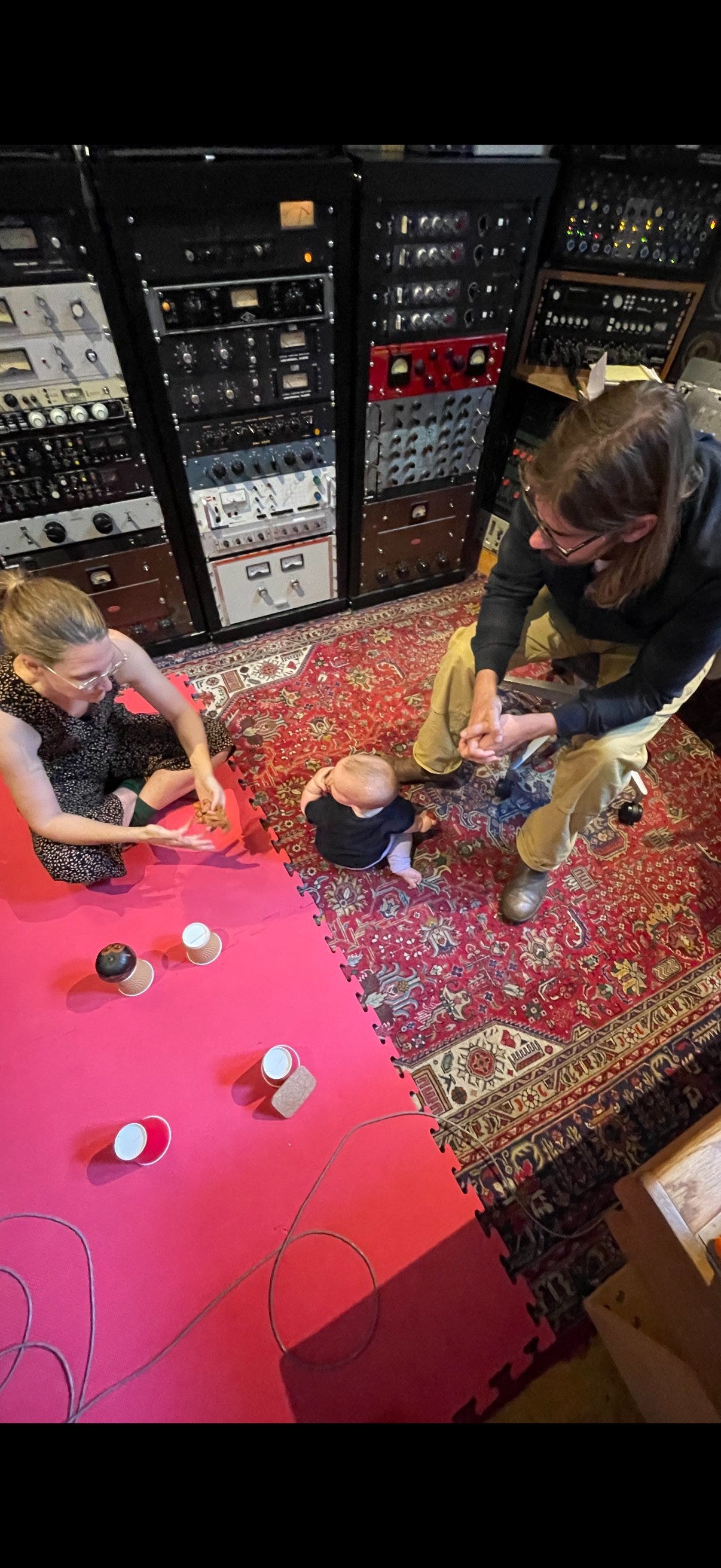
Laura: Oh my gosh, I’d totally forgotten that. Yeah, that’s where we would have met.
Dom Monks: I don’t think we met before. We might have briefly somewhere.
Laura: Ethan gave me a tour of Real World. And picked me up from Westbury Station. It was the first time I’d met Ethan, I think. And he was, like, dressed in triple denim. With purple round sunglasses and long hair and long beard. And he looked so random in that context. Yeah. And I couldn’t believe it. And then he took me to Real World and I sort of couldn’t believe how amazing it was. But then I think I probably insisted that we do it at East Coat for some, whatever, useful reason. But I don’t remember meeting you. I mean, it says so much about both of us that neither of us could remember meeting each other. But I remember sitting outside at Real World on a summer’s day having one of those amazing lunches that the chef’s put on. And you saying that you don’t like butter. And I remember thinking, that’s so weird. What a weird guy.
Dom Monks: Doesn’t like butter. It’s a lasting impression.
Laura: Dear diary, very odd chap.
Dom Monks: I remember meeting the kind of Mumford and Sons chaps for the first time there. It’s quite a hard thing to forget. The kind of whirlwind of, you know, no strings or no plectrums or no... whatever it was they were hunting down.
Laura: Deeply semi-professional at that point, apart from Ted, maybe.
Dom Monks: That and the song where you recorded it in the wrong tuning.
Laura: Oh, God. I mean, that sounds like me. That sounds highly likely. Never know what tuning I’m in.
Dom Monks: Well, it’s one of the strings you’ve done, like, an octave down instead of an octave up. I mean, I, you know, generally trying to keep my head down, as you should as a young engineer. But I do remember kind of piping up on that. Because I think your dad had come in to listen to it. And he was like, oh, you’ve done it in the wrong tuning.
Laura: I do remember that. And then from that day onwards...
Dom Monks: Because he had really latched on to the fact that one of the lower strings was actually higher than you’d expect it to be. It was higher than the next one in the sequence. Anyway, we used the original.
Laura: Yeah. And actually, since that day, because I was using his guitar for that song, it still has a piece of masking tape on the back with that tuning written on it. So whatever that is now, 20 years ago.
Dom Monks: That is it.
Laura: It’s a tuning for Made by Maid.
Dom Monks: Made by Maid, isn’t it?
Laura: Yeah. And so we’ve been in many different studios. There’s only one album that I’ve made since then that you haven’t been involved with. You’re not that much older than me.
Dom Monks: I wasn’t that much older than you. I remember that session because it was the first session where I wasn’t the youngest person in the room. And I think it was probably the last session I wasn’t the youngest person in the room.
Laura: Yes, I’ve passed that point. Well, I passed that point many years ago now.
Dom Monks: Yes. Now I’m just consistently the oldest person in the room. But I do remember how young you were.
Laura: Yeah. I was young and I was shy then.
Dom Monks: Quiet. Yes. Well, you were shy, but you were never a pushover.
Laura: No. Yeah. I didn’t have that problem.
Dom Monks: Yeah, you were definitely shy. At that age. I remember when we were at Rak, and the studio manager, Tricia, who was a fabulous character. She saw you walking to the studio, kind of pulled over and was like, Laura, do you want a lift? You were like, no. No, thanks. I’m going to walk by myself.
Laura: Yes. Yes, I have my routines that I stick to rigidly. Thank you, Tricia. She was fabulous. Yeah, so we’ve been in Rak, Real World, East Coat, which I don’t think is still going anymore. And...
Dom Monks: Air.
Laura: Air. And then... Oh, that... The Dyson one.
Dom Monks: Oh, Distillery.
Laura: Distillery. And then we did some at Ethan’s house. And then we’ve done some at your place. And then we did the last one at Cheese and Grain in Frome. And they all have such very distinct memories to me, the environments. Oh, then Wales. What was that one called?
Dom Monks: Oh, Mono Valley.
Laura: Mono Valley, yeah. See, we’ve been at some of the great studios of the Isles, I’d say. And some of them are no longer with us. It’s gone, isn’t it?
Dom Monks: Mono Valley is now... well, you can rent it as an Airbnb. But yeah, no longer a studio.
Laura: Yeah. And there was quite a lot of technical... it was a studio on its last legs, I’d say, much as it was a lovely place to record. Definitely crumbling at the edges. And then I think it was on that same record that we finished at Ethan’s house and he had inherited his dad’s, the famous, of course, Glyn’s desk.
Dom Monks: His console, yes.
Laura: His console, which was falling apart. Well, not falling apart, but it was this amazing inanimate Freudian drama. Like, it felt like Glyn was part of the session because the fucking console would not play ball every single day. It was the same bullshit. This very intimidating console.
Dom Monks: It was dying its own death.
Laura: It was playing out its own patricidal death. It was mental. But we got it done.
Dom Monks: We got it done. There’s nothing quite as bad as when stuff isn’t working.
Laura: Yeah. Well, I mean, it’s hardest for you, isn’t it, as the engineer. But also in all of those sessions, what I always found interesting about studio environments — particularly as you’ve been a consistent presence in pretty much all of them that I’ve been part of — is how the hierarchy of the studio works and how that’s changed over even just the short time that I’ve been part of that world. Definitely engineers have a personality type, I think, but which is why it’s interesting that you’ve done it all. And I think Ethan did it all too. Didn’t he? He had a different situation because his dad was such a big player.
Dom Monks: Yeah. He went off to assist him. And he went to America. No, quite the opposite in terms of a free ride. I think some people took offence. I mean, studios can be, especially big studios, incredibly competitive. When you have a lot of engineers and a lot of assistants, there are all kinds of stories. Assistants who get on sessions because they supply the drugs, or whoever’s sleeping with whichever studio manager. There used to be all kinds of hazing and all kinds of things.
Laura: Some good IP in there, Dom. My mind is racing. I mean, there’s a good HBO show in there. The Studio has already been done, but what about The Real Studio Assistants of a Dying Industry?
Dom Monks: It couldn’t be more different now. And it’s quite an odd balance to strike now because the human rights that have appeared for studio engineers are obviously wonderful.
Laura: Yeah. And that seems really recent to me. Cause I think even when I started, it wasn’t that way.
Dom Monks: I mean, it’s probably still a long way to go, but I was just expected to work any hour of any day.
Laura: Yeah. I couldn’t believe that side of it. You know, that young lady who was doing the Mono Valley session — she didn’t know if she was going to be finishing at six or one in the morning.
Dom Monks: She had no idea. Yeah. And you’d finish one session at six in the morning and start the next session at 10 in the morning for a different client. And they were all fresh, ready to go. And you hadn’t slept in a week. So I think that’s improved a bit, but like with anything that’s so oversubscribed, over interest always gets abused. Some people would say it’s being abused. Other people would say, well, it’s sort of the wheat from the chaff. But there are some studios that are so brutal that the engineers who made it through all seem to have PTSD. They were so affected by the trauma of some of those things.
Laura: That reminds me that Ethan felt like a vegetarian, you know, and I don’t mean literally like a vegetarian, but he felt like someone who’d grown up among omnivores and had adopted a vegetarian lifestyle. He was very, from what I saw, very good at controlling that environment for the most part and making people understand their place without going full metal jacket at them.
Dom Monks: Yeah. And he was always, and still is, incredibly good to me. I’m aware of just how lucky an experience I had, both in terms of Real World and how great a place it was, and then meeting Ethan. And one of the things I really got drawn to about sessions and studios was that there were so few people being assholes. I mean, I’ve done some TV set stuff where no one is working together. If you’re trying to have a conversation about getting a mic somewhere and you need to speak to a different department, they just wouldn’t give a shit. They’re just like, not my problem. Get lost. Get out my way. I’m doing my thing.
Laura: On that note, a lighting department hates to see you coming, doesn’t it, Dom?
Dom Monks: Oh yeah.
Laura: Nothing strikes fear in the soul of the TV lighting department more than Dom Monks strolling towards their cabin to tell them to turn it the fuck down.
Dom Monks: Yeah. Yeah. But it does endear me to the sound truck, who normally don’t like to see some producer showing up with opinions about what they’re doing. But when you can get all the lights to stop buzzing, they’re like, Oh, okay. I like this guy. But yeah, Ethan was amazing at all of that, and he’d seen that world and walked away to do his own thing. And he was amazing at kind of controlling those things. And Ethan was a guy who was never afraid of confrontation. I’ve been in the room for it — stories of really big artists dressing down their musicians in a very unnecessary way. And Ethan calling them out on it and putting a stop to it there and then.
Laura: He saved his willingness to enter into confrontation for the right direction. Didn’t he? It was always at the record label people. I mean, the record label people, when I was working with Ethan, didn’t even bother asking to come near. I never met any of my record label people ever because Ethan told me not to. And so they never came near anywhere. That’s changed, but it’s an interesting thing because that culture has really changed now. And maybe Ethan held onto the idea that the record label was the enemy for a bit longer than necessary. I don’t know where he’s at with that now, but it certainly does feel like that culture has really changed. Now that record labels aren’t the enemy.
Dom Monks: I think it was more connected to, you know, if you want to show up and be a part of this process, then show up. Be there every day. Don’t lob opinions in from the sideline, having not been on the journey kind of thing.
Laura: It was dignified. He made it a very dignified experience in that way. I think Ethan’s sense of the dignity of the studio — he kept a kind of dignity to the studio space, which I thought was just a given, but actually going out into the big wide world when I was doing other projects, I realized that it wasn’t. It was something that Ethan kept very sacred. And I’m very grateful for that.
Dom Monks: I have musicians come in sometimes and they seem to have a kind of PTSD, and they’ve really had terrible experiences of being in the studio. And they’re incredibly nervous. And they’re kind of like, well, just tell me how you want it to be. And I’m like, no, I want you to be you. I want your reaction to this. And sometimes you get this kind of, well, no one’s ever asked for that. You can feel like you’re coaching people out of that experience. But the studio is such a vulnerable place to be, and then have, in essence, all these magnifying glasses of microphones being put upon you for everyone to pour over and examine.
Laura: I mean, I hate to drag us here, Dom, but there is a psychosexual element. It sounds like we’re describing a libidinous analogy — a sense of security to perform an act literally that requires spontaneity and lack of self-consciousness. And that’s why I think a lot of drama happens in studio settings. You know, famously, it’s a setting of lots of different kinds of drama. And there’s a lot of psychological holding of a space that feels good for creativity, but it could be that that’s a very difficult double-edged sword because it also creates uncomfortable hierarchies or bad behaviour. It’s a really delicate balance that’s held in a studio, and people have their different forms of what feels right to them.
Dom, I’ve taken up 55 minutes of your time and I don’t want to take up too much more as you have thousands of children. I was going to ask — who is your favourite artist that you’ve ever worked with?
Dom Monks: Aside from yourself.
Laura: No, there was a really obvious, just one answer to that question that you could have just gone straight in with. Not aside from myself.
Dom Monks: Gosh, well, I could go very psychosexual here, but I won’t do that to you either.
Laura: God, please do.
Dom Monks: I guess there are moments of a purity of expression or happening that’s this kind of incredibly rare thing that only shows up every now and again. And it’s terrible cause I’m not going to remember the name. One of them was when we were at RAK doing Eagle. And you sat down — this was classic Ethan having his antenna at full extension. Nudging me. Cause you’d gone out to the live room with your coat on, cigarette in hand, and Ethan nudged me being like “hit record”. I hit record and you did... I can’t remember the name of the song now. Was it Night After Night?
Laura: Was it Night After Night?
Dom Monks: Yeah. And you did that performance and I was rolling tape and you kind of looked up to be like, you think that’s the right key? And we all just had our jaws on the floor knowing that something had really just happened. So that was one of those.
Laura: And then surely, I mean, I hate to interlope on your anecdote, but surely Change, the Big Thief song.
Dom Monks: Yeah, that was incredible. That’s gotta be one of the greatest takes in living history. Not accident — on purpose. Well, there were a couple of Big Thief ones which I think really endeared me to that camp. I mean, the biggest thing I’d learned from working for Peter Gabriel, working with Dickie Chappell, was just — record everything. It’s not your job to get the perfect sound. It’s your job to make sure you don’t miss the fucking incredible thing that happens. And if it’s incredible, it doesn’t really matter what mic is on it. It’s that you actually record it. So whenever Peter walked in the room, I had to be rolling, cause with Peter, if he fell on the keyboard and made an interesting chord, he’d want to hear that chord back.
So that was an amazing lesson to learn. But when we were doing UFOF, I’d just flown in, quite jet lagged. So I was up super early and I could hear Adrianne out on the porch playing on this 12 string and it was, I mean, clearly an amazing thing, but it had the energy of someone who had just written it. So they had an excitement in it. That’s hard to recreate. She kind of walked into the live room and James was eating cereal. And he just sat on the drum kit and started playing. So she had kind of no idea that one was recorded. But a similar thing happened with Change — she bounced into the control room and I think it’s only James and I were there and she’s like, I’ve just written a song. Do you want to hear it? And we’re like, yeah, of course. And she played one chord and I stopped her. Do you want to do that in front of the microphone? Cause I just knew what was about to happen.
Laura: Well, as you say, that energy of just having written a song is really special. And also that energy of the band dripping into the studio in the morning. That’s a really special energy. You know, the first time they’re all picking up their stuff, somebody’s playing, they will start joining in. There are these special recurring moments that are always worth capturing. And I also think that the idea that the sound isn’t as important as the moment is definitely on the side of the philosophy that I believe in. You balance that philosophy really well, obviously, because you’re an engineer and producer and both things are important to you, but I’m so much more like — I really believe in taking the pressure off sound and putting the pressure on the moment in a way.
Dom Monks: Yeah, I think it’s a very kind of intertwined relationship as I see it. And as much as I see the sound or the engineering or the mixing aspect or even mastering, I only really see those elements as like the doors — how wide can you open these doors to perception? And it’s not like it doesn’t relate to fidelity or fancy mics or anything. You know, the doors can open wider cause you stuck it on a cassette tape, or anything can cause it. You don’t know why the doors are going to open wider. But you also don’t know how wide they open at all. And you also don’t know how bright the thing behind them is shining. But when the thing that’s behind the door is shining that brightly, you only need to get them open a crack to have an amazing experience.
Laura: Yeah. I didn’t know how you were going to round out that metaphor and it worked out really well for you. Didn’t it? Were you pleased with that? Really, really good.
Dom Monks: Well, that’s a metaphor that long exists. That’s kind of in my explaining of things when I do it with students. You know, when they’re mixing and they’re like, what on earth am I doing? What is it I’m looking for? Especially when they’re in a very sciencey or technical head of like, are there rules to this? And it’s like, no, sorry. There are no rules. You’re just trying to open the doors on this thing by whatever means. And what’s doubly frustrating is if you’re just handed something to mix — you don’t know how good you can make it. You know, like working with Chad, cause Chad was mixing a lot. I’d set up the console and label all the faders and make sure everything’s working. So he could just sit down and push the faders up. And you’d be there thinking, this is alright, maybe not thinking it was that good or that well recorded. And with a matter of like 10, 15 minutes, it was just absolutely blowing you away.
Laura: Yeah. I’ve seen you do that to things so many times.
Dom Monks: And you were there scratching your head going, okay, there’s clearly something going on that I’m not able to do yet, or just don’t understand. But yeah, there’s just having to remind yourself perpetually that maybe you think you’ve done as good as you can, but actually there’s a whole other layer to it that you haven’t yet found or discovered through, probably, lack of creative thinking or lack of playing with it.
Laura: On that note, and as I round us out here — I’m currently recording on an SM7 and a Zoom binaural mic. How does that make you feel?
Dom Monks: It makes me feel great.
Laura: Oh, good. Okay, good. I get away with that one. Always feel like I might get told off. I also just bought a teenage engineering field recording set-up. Like, the whole kit.
Dom Monks: Awesome.
Laura: But I don’t know how to use it and you’re not available to talk me through it and I don’t want to make you do that. So I’m going to use this part of the interview to plug selling that teenage engineering field recording kit. Cause it’s no use to me cause I’m never going to learn how to use it. So if anybody would like to buy it off me, they’re more than welcome. I’ve paid the import duties.
Dom Monks: Well, you know, don’t write yourself out the equation yet, Laura.
Laura: I will never have time. In a former life I would have had time to sit down and figure it out, but I’m just going to have to sit with my SM7 and my Zoom binaural mics to record a bunch of children’s music. Did I tell you that I’m doing that?
Dom Monks: I heard about it from your writings, which is very exciting. I’ve been having a similar idea, which I haven’t done anything with. I had a conversation with The Staves and I’ve been reminded how much — what wonderful memories I had of them just hanging out in the studio, singing Disney and like Robin Hood songs.
Laura: Oh, Dom, we’re going to be in competition here. Well, I’ve already recorded the Robin Hood songs. Okay.
Dom Monks: Well, you’ve got them then.
Laura: No, I’m joking. Let’s just fill the world with more Robin Hood sounds. You mean the original one, the sixties one?
Dom Monks: Yeah, yeah. But yeah, they’d sing it in like three part harmony that they’d just made up.
Laura: Well, not all of us have sisters who can sing in three part harmony.
Dom Monks: No. But it got me thinking about how, you know, just how bad children’s music is.
Laura: It’s so bad. And it’s got so much worse. I mean, with AI and YouTube and all this shit, I really welcome an influx of just music that’s not made in nefarious circumstances. That’s all I’m asking.
Dom Monks: I mean, even in schools — having grown up where my mum was doing every music group and every assembly, you know, there’d be someone sat there playing a piano. And now with my kids in school, they’re singing to a backing track that’s not in the right key, that doesn’t slow down with them or speed up with them or follow them. And you get this really kind of terrible karaoke experience and it doesn’t let them into the magic of music hardly at all.
Laura: Yeah. So true. We had Mrs. Whatever who played all the piano in the morning and in the afternoon, sing a song before you go home.
Dom Monks: And a good accompanist will, you know, can elevate anyone. Anyway, I’m so glad that you’re doing it because I have not organised myself.
Laura: Well, you’d make it sound beautiful. And The Staves have their incredible, freaky, sisterly harmony talents. I look forward to hearing that.
Dom Monks: Well, I mean, yeah, we’ll see. The idea was to get loads of different people involved.
Laura: Maybe we should be doing this in collaboration, Dom.
Dom Monks: Maybe we should.
Laura: I want to get a band together to do the next one. I’ve done the first two solo and then I’m doing a French album of French songs, and then I’m doing originals and I want to get a band together for the originals. So I’ll be in touch.
Dom Monks: Oh, brilliant. Oh, very exciting. I wanted, you know, I wanted to call you and like get Michael Kiwanuka involved.
Laura: Yeah. Cause we’re all having kids, aren’t we?
Dom Monks: Yeah. Everyone’s got kids, and I want to be like, well, okay, what songs do you love that you would never normally have reason to record or perform? And how many new parents there are who would just love to have something like that they can put on that isn’t shit and just programmed.
Laura: And comes with loads of merchandising and shit like that.
Dom Monks: Yeah. Okay, great.
Laura: Well, hopefully this will be my way of actually getting to do something with Michael. That would be great. Right, I’m going to have to go because I’ve left my children alone for too long.
Dom Monks: Go see to them.
Laura: Thank you so much for doing this.
Dom Monks: It’s my pleasure. I hope your readers are not too bored.
Laura: Yeah. Who knows. I’m sure they won’t be. Lots of love. Happy Easter.
Dom Monks: Lots of love. Rebecca sends her love.
Laura: Send lots of love. And to the crew as well. To the clan. Likewise. All right. Speak soon. Bye.
This was a fascinating long read. I could’ve read more and more. Laura, you are a very fun interviewer because you ask the best questions and propel the convo further. You’d make a great podcaster. My father built one of the first home studios in LA for small ensemble film scoring. I was his assistant, especially when he took on a pop project and he needed Beatles-raised-me to decode his “classical” ears. Like that woman, a 6pm scheduled stop would end at 4am and my job started at 8am; this went on for months and it destroyed my relationship with him. I’m glad Ethan was empathetic. I bet Blake Mills was the same.
Excited for your children’s stuff! My kids and I have been loving listening to your raffi record. We’re desperate for more!